publications
Find here my research papers, conference contributions, and journal articles.
Journal Articles
2026
- Separator for the remoteness constraintQuentin Brateau, Fabrice Le Bars, and Luc JaulinInternational Journal of Approximate Reasoning, 2026
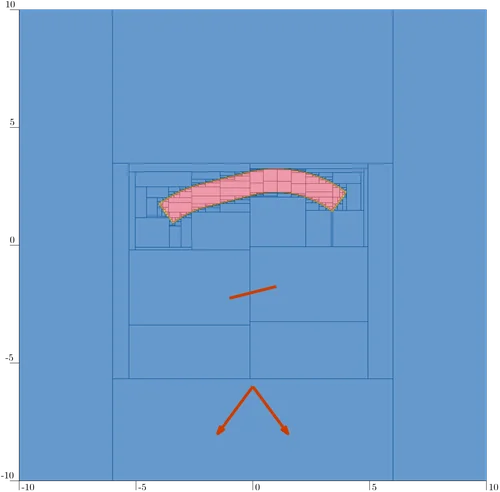
Reliable state estimation for autonomous systems in structured environments frequently depends on acoustic and ultrasonic range sensors. Unlike high-resolution LiDAR, these sensors possess a significant angular aperture, where the measurement follows a first echo principle returning the minimum distance to any obstacle within a sensing cone. This measurement model introduces non-differentiable “min” operators that are inherently difficult to handle with classical probabilistic filters like the Extended Kalman Filter (EKF). This paper proposes a guaranteed state estimation framework based on the remoteness constraint, originally introduced as an inclusion test but limited by computational inefficiency. We present an implementation of the Remoteness Separator within the framework of separator algebra, enabling the use of efficient contraction techniques to prune the state space. A core contribution of this work is the derivation of an efficient implementation which does not generate fake boundaries, thus maintaining the topological integrity of the solution set and enhancing computational performance. The approach is evaluated through a state estimation benchmark in a structured environment, providing a mathematically guaranteed enclosure of the robot’s pose. This implementation is restricted to the two-dimensional case with obstacle segments, but the underlying principles could be extended to more complex geometries and higher dimensions.
- Navigation Without Localization Using Stable CyclesIEEE Journal of Oceanic Engineering, 2026
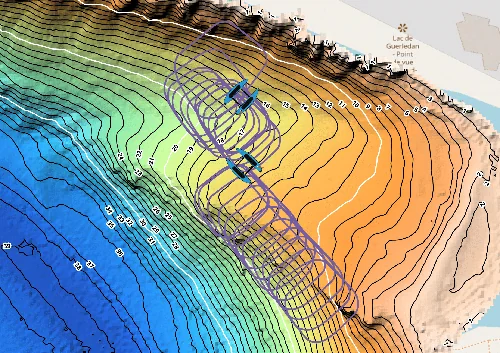
Navigating autonomous robots in GNSS-denied environments, such as underwater, remains a fundamental challenge due to the lack of reliable localization. Classical approaches rely on exteroceptive sensors and complex state estimation pipelines, which are often computationally expensive, not-precise, and unsuitable for stealthy or resource-constrained platforms. In this article, we propose a novel, frugal navigation paradigm based on stable cycles, inspired by biological navigation strategies observed in migratory animals. Our method enables a robot to follow and stabilize a predefined cycle in the environment without requiring explicit state estimation. A timed automaton is used to generate control inputs that drive the robot along a discretized cycle, which is then stabilized in the world frame using sparse environmental measurements. We formally describe this cycle-based control framework, provide a proof of its stability, and validate the approach experimentally on a real robot. This work opens a new direction for low-cost, low-observability robotic navigation in unstructured and GNSS-denied environments.
@article{brateau2026joe,
  author = {Brateau, Quentin and Degorre, Loïck and Bars, Fabrice Le and Jaulin, Luc},
  journal = {IEEE Journal of Oceanic Engineering},
  title = {Navigation Without Localization Using Stable Cycles},
  year = {2026},
  volume = {51},
  number = {2},
  pages = {1129-1138},
  keywords = {Navigation;Robot sensing systems;Sensors;Location awareness;Global navigation satellite system;Dynamical systems;State estimation;Automatic control;Autonomous underwater vehicles;Underactuated surface vessels;Automatic control;autonomous underwater vehicles;navigation;uncrewed surface vessels},
  doi = {10.1109/JOE.2026.3652057},
}
2025
- Proving the stability of cycle navigation using capture setsMechatronics, 2025
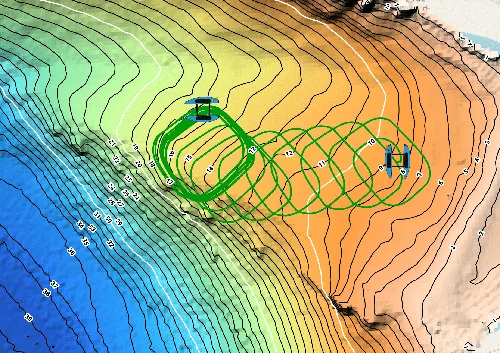
Navigating Autonomous Underwater Vehicles (AUVs) presents significant challenges due to the absence of traditional localization systems. Cycle navigation emerges as a promising paradigm, enabling reliable navigation using minimal exteroceptive measurements. This approach leverages predefined cyclic trajectories, which are stabilized based on environmental feedback, ensuring frugal and discreet operations without reliance on high computational power or extensive sensor systems. This work aims to prove the stability of the cycle navigation. As cycle navigation is a non-linear system governed by a discrete inclusion condition, conventional methods have trouble to prove its stability. For this reason, this paper focuses on set methods to prove the stability of cycle navigation. The stability is proven by exhibiting a positive invariant set, which is a set stable by application of the evolution function of the system. This ensures that the evolution function will not remove states from the positively invariant set. Then, the characterization of the capture basin is an asset when performing cycle navigation, as it represents the set of initial states for the system which leads to the positive invariant set. Once the system reaches either the capture basin or the positive invariant set, which are generalized as a capture set, it remains captured forever. This approach not only guarantees the stability of the system in the neighborhood of the equilibrium point, but also establishes that it exists an area in which the stability of the cycle navigation will lead to a stable behavior. This work offers a robust, computationally efficient alternative to traditional stability methods, particularly suited for resource-constrained AUVs, because the underwater environment lacks suitable, cheap and easy-to-use localization methods, which forces us finding alternative ways to navigate and explore this particular environment.
@article{brateau2025ifac, title = {{Proving the stability of cycle navigation using capture sets}}, author = {Brateau, Quentin and Degorre, Loïck and Bars, Fabrice Le and Jaulin, Luc}, journal = {Mechatronics}, volume = {110}, pages = {103385}, year = {2025}, issn = {0957-4158}, doi = {https://doi.org/10.1016/j.mechatronics.2025.103385}, url = {https://www.sciencedirect.com/science/article/pii/S0957415825000947}, keywords = {Underwater robotics, Mobile robots and vehicles, Set methods, Stability}, } - Considering Adjacent Sets for Computing the Visibility RegionQuentin Brateau, Fabrice Le Bars, and Luc JaulinActa Cybernetica, Nov 2025
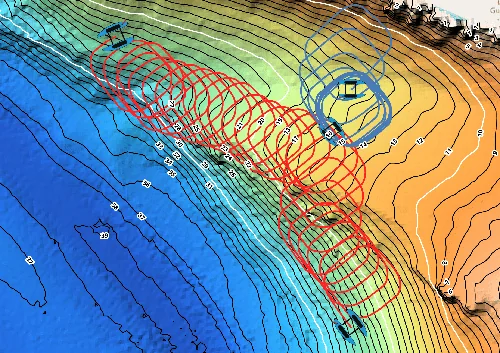
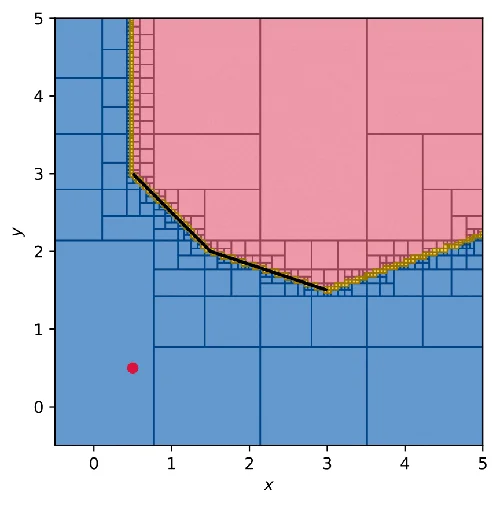
This paper explores the problem of the paving of the union of adjacent contractors. The focus is first put on the analysis of the topology of a set operator, which can be stable or not stable. Then, depending on the stability of the union operator, solutions are proposed to avoid fake boundaries in stable and non-stable union of sets. For stable unions of sets, a boundary preserving form will be developed to add a set overlapping the fake boundary in the expression of the union, whereas for non-stable union of sets, a boundary approach will be developed to avoid fake boundaries. Some problem-specific solutions are also developed to avoid fake boundaries. As an example, an enhancement of the separator on the visibility constraint is proposed. This avoids fake boundaries while characterizing the set of non-visible points from an observation point relative to a polygon.
@article{brateau2025acta,
  author = {Brateau, Quentin and Bars, Fabrice Le and Jaulin, Luc},
  title = {Considering Adjacent Sets for Computing the Visibility Region},
  journal = {Acta Cybernetica},
  year = {2025},
  month = nov,
  volume = {27},
  number = {3},
  pages = {475-492},
  url = {https://cyber.bibl.u-szeged.hu/index.php/actcybern/article/view/4560},
  doi = {10.14232/actacyb.314640},
}
2022
- Acoustic source localization in underwater environment using set methodsQuentin Brateau, Luc Jaulin, and Benoit ZerrProceedings of Meetings on Acoustics, Nov 2022

The study of underwater acoustic wave propagation provides solutions to localization and underwater navigation problems. In these cases, simulation can be a powerful tool for a better understanding of acoustic propagation. These simulations are based on models that rely on simplifying assumptions allowing the numerical resolution. Simulation is also used to solve more specific problems in underwater environments. For instance, acoustic source localization using receivers in an underwater scene is still a challenging problem and has both civil and military applications. Classical methods are based on the use of acoustic receiver arrays placed in the environment. Assuming a normal modes model for the propagation, collected data are then processed, for example, by singular value decomposition or matched field processing based approach, which provides probabilistic results. The proposed approach to solve this problem is to use set methods. This method allows enclosing all source positions compatible with the recorded hydrophone signal. In addition, possible sets for source position compatible with each receiver can be intersected to increase the certainty of the source location. Besides requiring a good knowledge of the scene, this method requires simulating the acoustic propagation as well as possible to correctly solve this localization problem.
@article{brateau2022acoustic,
  author = {Brateau, Quentin and Jaulin, Luc and Zerr, Benoit},
  title = {{Acoustic source localization in underwater environment using set methods}},
  journal = {Proceedings of Meetings on Acoustics},
  volume = {47},
  number = {1},
  pages = {070023},
  year = {2022},
  month = nov,
  issn = {1939-800X},
  doi = {10.1121/2.0001643},
  url = {https://doi.org/10.1121/2.0001643},
}

Conference Proceedings
2025
- Stable Cycles for Underwater NavigationQuentin Brateau, Fabrice Le Bars, and Luc JaulinIn OCEANS 2025 Brest, 2025
Navigating GNSS-denied environments presents significant challenges. This is one of the challenges faced by underwater robotics. Underwater localization solutions are still expensive and difficult to integrate into small robots. This paper proposes to take advantage of stable cycles to enable navigation without getting lost. The robot is following a timed automaton that guides it along a predefined trajectory. By tuning the timings of the automaton based on measurements, the cycle is moved and stabilized in the environment. Several of these cycles may exist in areas to be explored. The goal of this paper is to provide strategies to navigate between these cycles, either using dead-reckoning for short-range navigation or using an isobath bounce strategy to reach the capture basin of the next cycle and to be sure to stabilize the trajectory of the robot on the next cycle.
@inproceedings{brateau2025oceans,
  author = {Brateau, Quentin and Bars, Fabrice Le and Jaulin, Luc},
  booktitle = {OCEANS 2025 Brest},
  title = {Stable Cycles for Underwater Navigation},
  year = {2025},
  volume = {},
  number = {},
  pages = {1-7},
  doi = {10.1109/OCEANS58557.2025.11104656},
  keywords = {Dead reckoning;Navigation;Automata;Switches;System recovery;Underwater navigation;Trajectory;Timing;State estimation;Tuning;Marine Robotics;Navigation;State Estimation;Autonomous Underwater Vehicles}
}